27.6°
The Prophet’s Mosque
Madinah
The Second of the Two Holy Mosques
Madinah
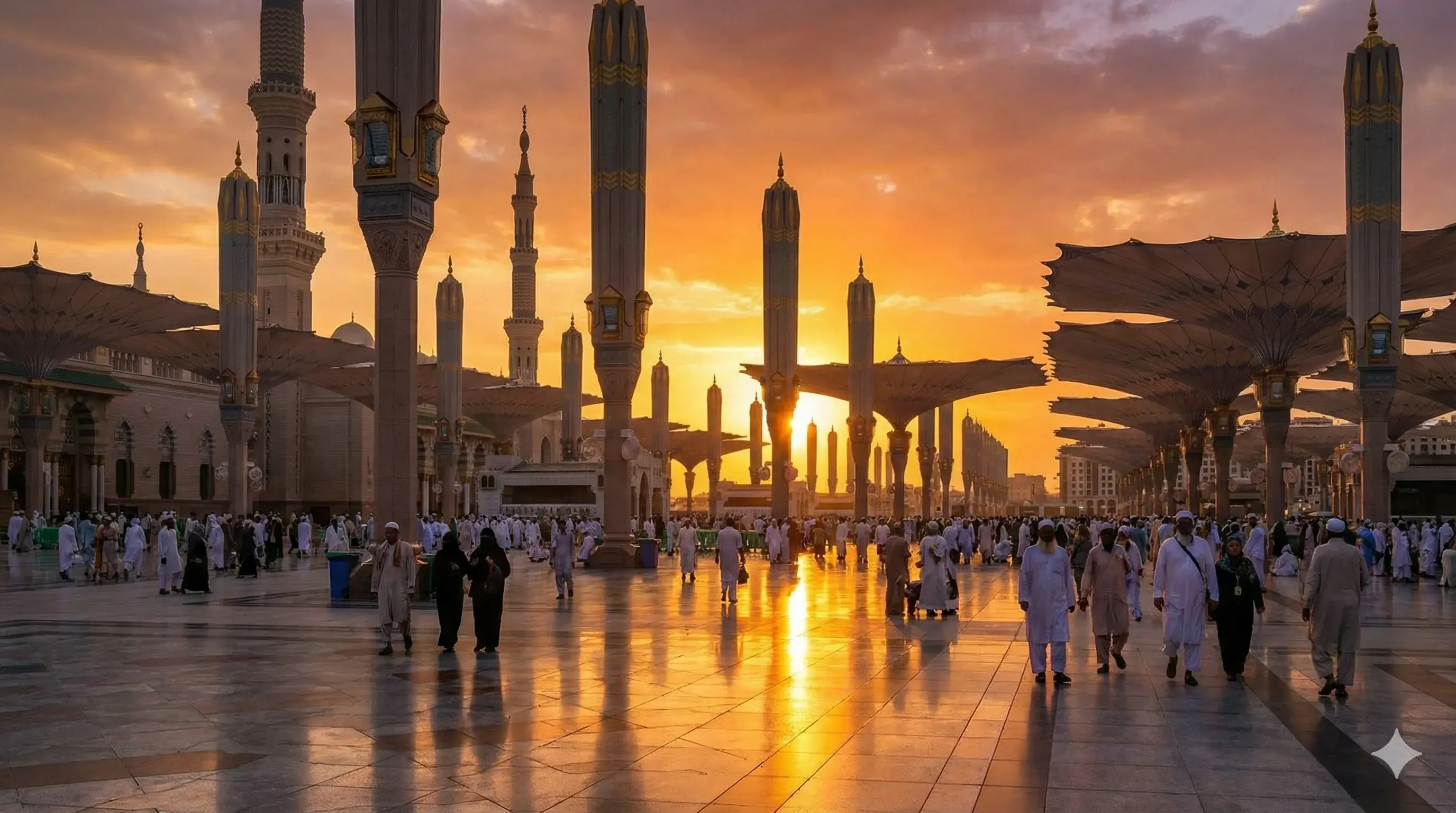
The Prophet’s Mosque is situated in the centre of Madinah. It was the first building established by the Prophet (PBUH) upon his arrival in the city, where he participated in its construction alongside his Companions (may Allah be pleased with them), personally carrying mud bricks and stones (peace and blessings be upon him).
At first, the mosque was simple in its construction; it was built on a plot of land measuring approximately 30x35 meters, with foundations of stone and walls of mud bricks. Initially, it had no roof, but later a shaded area (Thullah) of three porticos was added.
Seven years after the Hijrah, it was expanded during the Prophetic era from the eastern, western, and northern sides. It came to consist of a central courtyard surrounded by two shaded areas, and the eastern wall of the mosque became adjacent to the chambers of the Prophet (PBUH).
The Rightly Guided Caliphs paid great attention to the Prophet’s Mosque; it was expanded during the reign of Caliph Umar ibn al-Khattab (may Allah be pleased with him). During the reign of Caliph Uthman ibn Affan (may Allah be pleased with him), he ordered the mosque to be demolished and reconstructed, increasing its area and building it with carved stone and plaster, making its columns of engraved stone.
The mosque remained as it was for nearly sixty years until the Umayyad Caliph Al-Walid ibn Abd al-Malik carried out a significant reconstruction through his governor of Madinah, Umar ibn Abd al-Aziz. The construction was completed in 91 AH / 709 AD, and in this expansion, the chambers of the Prophet (PBUH) were incorporated into the mosque's area.
During the Abbasid era, the Abbasid Caliph Al-Mahdi ordered its reconstruction, and the expansion of the Noble Mosque during his reign was limited to the northern side by 33 meters.
The Prophet’s Mosque was also renovated by the Mamluk sultans without expansions; among their most important renovations were those ordered by Sultan Qaitbay. Similarly, during the reign of the Ottoman sultans, the mosque witnessed numerous renovations and expansions.
With the advent of the Saudi era, the Prophet’s Mosque witnessed its most significant expansions, taking on its current beautiful form, which is considered a masterpiece of 21st-century architecture. It remains the focus of state attention and care to this day, since the era of King Abdulaziz and his sons after him—may Allah have mercy on them—Saud, Faisal, and Khalid.
During the reign of King Fahd ibn Abdulaziz, may Allah have mercy on him, the Prophet’s Mosque witnessed its largest expansion in Islamic history. This expansion covered most of the area of old Madinah, and the finest and most expensive materials were used in its construction, including alabaster, marble, precious woods, valuable metals, and electric umbrellas. This expansion preserved the mosque's previous Islamic architecture and harmonized it with modern Islamic architecture.