23.8°
Hassat al-Naslah
Qassim
A Rock Record in Ghaf al-Jiwa
Qassim
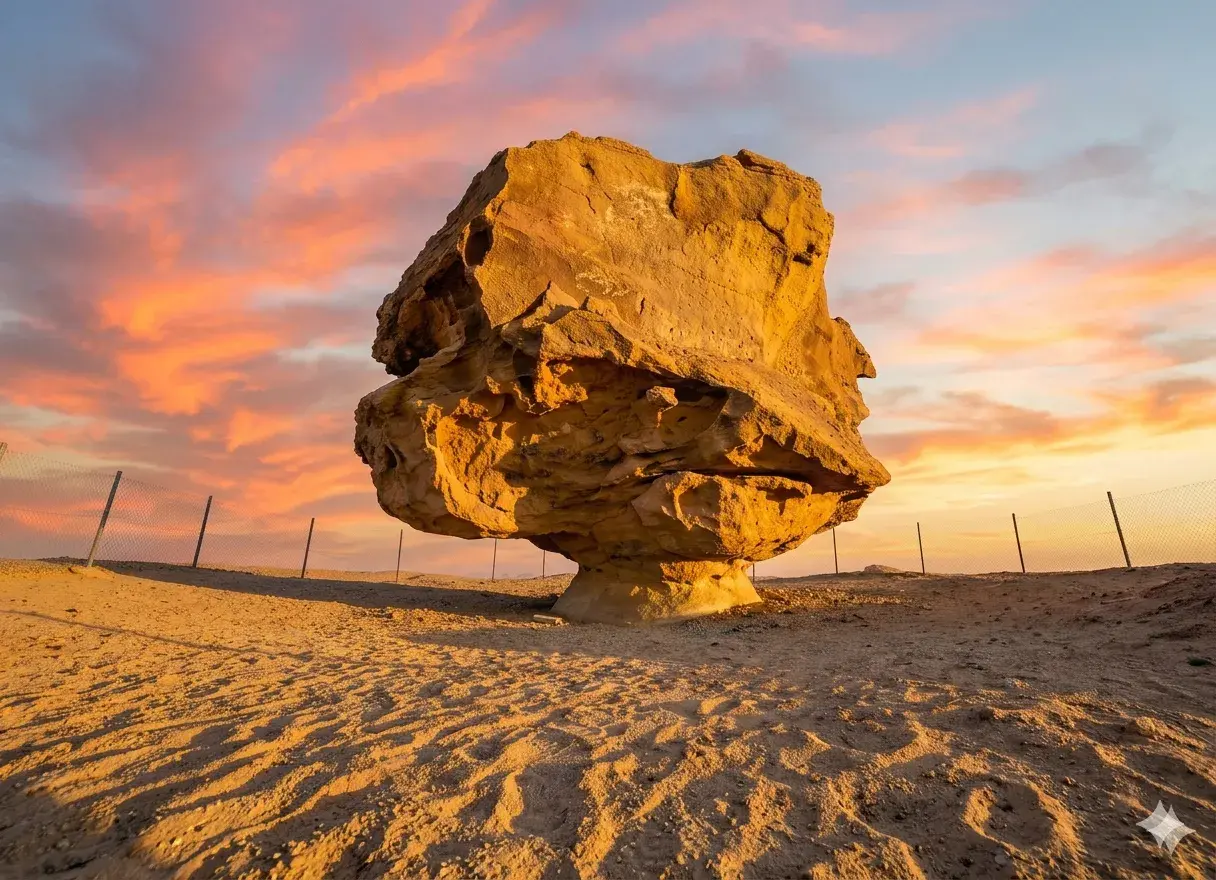
Hassat al-Naslah is one of the sites containing ancient inscriptions. It is a red-colored sedimentary rock formation, detached from the mountain range that surrounds the town of Ghaf al-Jiwa from the north and east.
It constitutes a prominent landmark along the routes historically used by travelers. The designation of Hassat al-Naslah, a rocky mound, stems from the belief that it was detached (in Arabic, nusilat, that is, broke away from the edge of that mountain range).
This belief is incorrect as it is naturally connected to the rocky ground and not separated from it. It is also known to some as Antarah’s Rock, named after Antarah ibn Shaddad al-Absi.
This is due to its location within the territorial boundaries of his tribe’s settlements. Moreover, one of the principal routes used by travelers to and from al-Jiwāʾ, running north–south, passes between the rock and the mountain range to its east.
Al-Uqaylat merchants from Najd in general, and those from Al-Qassim and al-Jiwa in particular, frequented this road constantly, illustrating the vital role the site played within the ancient trade-route network.
Accordingly, this route was used in antiquities; therefore, examples of Thamudic and Nabataean inscriptions on nearby rocky mounds.
As is the case with Al-Nuslah Rock, whose surfaces bear Thamudic inscriptions; some of these surfaces were easily accessible to both riders and pedestrians, while others required the use of a mount or a ladder to be carried out.
In addition to a diverse group of rock drawings of animal figures, Hassat al-Naslah thus becomes a rock record documenting successive phases of human history through the inscriptions it bears.